
Pump.fun Fees Explained: Trading, Creation and Network Costs (2026)
Pump.fun charges a small percentage fee on every buy and sell (historically around 1% on the bonding curve), plus Solana network fees of a fraction of a cent. Creating a coin is free or near-free apart from network costs, and optional priority fees can speed up trades. Using the referral code NEWUSER50 does not change the fees you pay.
Why fees matter more than you think
On a memecoin launchpad, trades are often small, frequent and fast. A fee that looks tiny on a single trade can add up quickly when you buy and sell several times a day. Understanding exactly what you pay, and when, helps you avoid a common trap: being slightly profitable on paper but losing money after costs. You can copy the pumpfun referral code and the join link in one click.
Pump.fun's fee structure has changed over time, and the platform has experimented with different rates for different stages of a token's life. The numbers in this article reflect the general structure as publicly described; always check the current figures shown in the trade window before confirming, because that is the final word.
The main types of fees
| Fee | When you pay | Typical size | Who receives it |
|---|---|---|---|
| Trading fee | Every buy and sell on the bonding curve | About 1% of trade value (varies) | Platform (part may go to creators/referrers) |
| Network (base) fee | Every Solana transaction | ~0.000005 SOL | Solana validators |
| Priority fee | Optional, to speed up trades | You choose | Solana validators |
| Coin creation | When you launch a token | Free or small network cost | Network |
| DEX fees after migration | Trading once a coin graduates | Set by the DEX pool | Liquidity pool / DEX |
The trading fee is the one that matters most for most users. Network fees on Solana are extremely low compared with other blockchains, but priority fees can become significant if you set them high during busy periods.
How the bonding curve affects your cost
Every new coin on Pump.fun starts on a bonding curve: a formula that sets the price based on how many tokens have been bought. Early buyers pay a lower price; as more people buy, the price rises automatically. There is no order book and no counterparty in the traditional sense, you trade directly against the curve. The pump fun app referral code works the same on desktop and mobile.
This creates a hidden cost called price impact. If you buy a large amount relative to the coin's current size, your own purchase moves the price up while you are buying, so your average price is higher than the price you saw. Slippage settings control how much movement you will accept before the trade fails. Setting slippage very high can protect you from failed transactions, but it also exposes you to buying at a much worse price.
Once a coin reaches a certain market cap, it "graduates" and its liquidity moves to a decentralized exchange. From then on, fees are determined by that exchange's pool rather than by Pump.fun's bonding curve.
Worked example
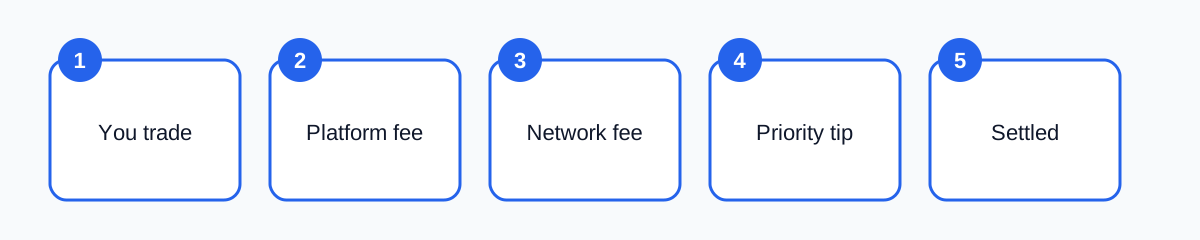
Imagine you buy 1 SOL worth of a new coin. With a 1% trading fee, about 0.01 SOL goes to fees and 0.99 SOL is used to buy tokens. The network fee adds roughly 0.000005 SOL, and if you set a priority fee of 0.0005 SOL, that is added too. Later you sell the tokens for 1.2 SOL; another 1% (0.012 SOL) is taken, plus network and priority fees.
| Step | Amount (SOL) |
|---|---|
| Buy value | 1.000 |
| Trading fee on buy (1%) | 0.010 |
| Sell value | 1.200 |
| Trading fee on sell (1%) | 0.012 |
| Network + priority (2 tx) | ~0.001 |
| Net profit | ~0.177 |
The lesson: a round trip costs a little over 2% before price impact. If you trade the same coin in and out ten times, you could spend more than 20% of your capital on fees alone.
Priority fees: when to use them
Solana processes transactions very quickly, but during busy moments, for example when a popular coin launches, many traders compete for the same block space. A priority fee is an optional tip that asks validators to include your transaction sooner. Pump.fun and most wallets let you set it manually or choose a preset. For the current status, see our verified NEWUSER50 referral code page.
For casual trading, a low or default priority fee is usually enough. Raising it makes sense only if your trades keep failing or you are deliberately trying to be early on a launch. Keep an eye on it, because a high priority fee on many small trades can quietly cost more than the trading fee itself.
Does the referral code change your fees?
No. The referral code NEWUSER50 does not add any charge and does not reduce what you pay. Referral rewards are paid from the platform's share of fees, which is why referral programs exist at all: they are a marketing cost for the platform. You can read the details in our article Pump.fun referral rewards explained, and get the code on our Pump.fun referral code page.
How to keep your costs low
- Trade less often and with a plan, rather than flipping in and out.
- Keep slippage reasonable; very high slippage invites bad fills.
- Use default priority fees unless trades fail.
- Avoid buying large amounts into very small coins, where price impact is highest.
- Check the fee preview in the trade window every time, because rates can change.
Fees are not the only risk on Pump.fun, and usually not the biggest. Most newly launched coins fall in value, and some are created purely to attract buyers before the creator sells. Use only money you are prepared to lose entirely. Always apply the pump fun referral code before your first login.
Pump.fun fees vs other ways to trade memecoins
| Venue | Typical trading cost | Notes |
|---|---|---|
| Pump.fun bonding curve | ~1% per trade + tiny network fee | Earliest access to new coins |
| Solana DEX after graduation | Pool fee, often 0.25–1% | Price set by liquidity pool |
| Trading bots on Telegram | Often 0.5–1% bot fee on top | Extra counterparty and security risk |
| Centralized exchanges | 0.1–0.5% | Only list coins after they grow |
The comparison shows why Pump.fun is popular despite its fee: it is the place where coins exist first. By the time a token reaches a large exchange, most of the early price movement has already happened. Whether that early access is worth the cost depends on your strategy, but for beginners it is usually wiser to trade less and learn more.
Hidden costs beginners overlook
Beyond the visible fees, several costs are easy to miss. Failed transactions still consume network fees, so repeatedly retrying a trade with too-low slippage adds up. Token account rent on Solana is a small deposit of SOL held when you receive a new token; it can often be reclaimed by closing empty token accounts in your wallet. Exchange withdrawal fees apply when you move SOL from an exchange to your wallet, and they are sometimes larger than all your Pump.fun trading fees combined. If you have not signed up yet, grab the pumpfun referral code on our main page first.
Finally, the biggest cost is not a fee at all: it is buying a coin that goes to zero. Fee efficiency matters, but choosing fewer, better-researched trades matters far more.
Fees and the pump fun referral code
A common question is whether a pump fun referral code like NEWUSER50 gives you a discount. On its own, a referral does not reduce your fee; it simply links your account to a referrer who receives a share of the platform's revenue. If Pump.fun ever runs a promotion that gives referred users reduced fees, it will be shown in your account. Either way, signing up with a code is free, so there is no cost to using pump.fun/join/NEWUSER50 when you create your account.
Checklist before every trade
Run through this before you tap buy: confirm the coin's contract address on its page, check the fee and total shown in the preview, set slippage to a level you are comfortable with, keep priority fees at default unless trades fail, and make sure you have enough SOL left for the sale later. A thirty-second check can save far more than any discount ever would, and it becomes a habit after a few trades.
Summary
Pump.fun fees come in three layers: the platform trading fee on each buy and sell, Solana's very small network fee, and optional priority fees. Creating a coin is cheap, but price impact and slippage can make trading more expensive than the headline fee suggests. A referral code is free and does not change any of these costs. To sign up with the code, start from our Pump.fun referral code page or the sign-up guide.
Ready? Get the code on our Pump.fun referral code page.
Frequently asked questions
How much is the Pump.fun trading fee?
Historically around 1% per trade on the bonding curve; always check the current rate in the trade window.
Is it free to create a coin on Pump.fun?
Creating a coin is free or nearly free, apart from small Solana network costs.
What is a priority fee?
An optional tip to Solana validators to process your transaction faster.
Does NEWUSER50 change my fees?
No. Fees are identical with or without a referral code.